

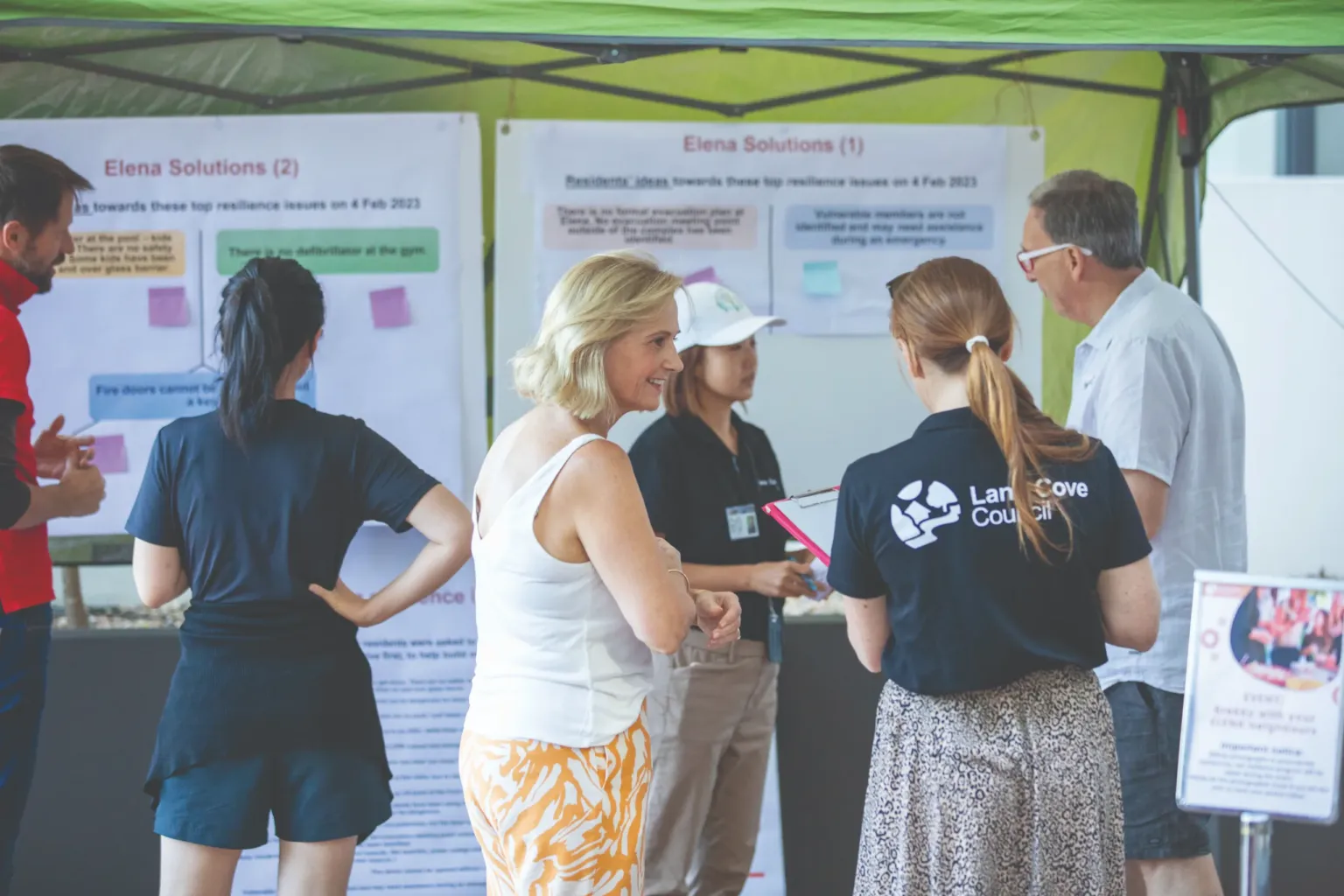
More than any other level of government, local government can play significant roles in strengthening social cohesion. With deep knowledge and existing connections to their communities, local governments already deliver services that influence social cohesion outcomes, both directly and indirectly. Building on existing services and working in partnership across government, businesses, services and communities, local councils are well placed to deliver place-based initiatives that address local challenges and build stronger, more resilient communities.
Social cohesion is about having strong bonds between individuals and institutions within a society, resulting in positive quality of relationships that are rooted in equal and just treatment, respect and care for one another. Social cohesion is an important foundation for cooperation towards shared outcomes. It depends on equity and the inclusion of all groups in society. Socially cohesive communities work towards the wellbeing of all members, fight exclusion and marginalisation, create a sense of belonging, promote trust and provide opportunities for civic participation and upward mobility.
Research indicates the benefits of social cohesion include increased resilience, increased local economic prosperity and improved health outcomes. Research also shows that connected communities, with strong networks, trust, social spaces and bonds, recover quicker from adversity. Resilient Cities Networks’ Social Cohesion: A Practitioner’s Guide to Measure Challenges and Opportunities notes that higher levels of social cohesion and positive social interactions serve to strengthen the overall fabric of the city, allowing communities to bounce back faster and rebuild more efficiently after experiencing major shocks and stresses.6 At the same time, a lack of social cohesion, including social divides, marginalisation and inequality, can be a major stress in itself and can lead to civil unrest and undermine community wellbeing. Findings from the Scanlon Foundation’s Mapping Social Cohesion Survey suggest that NSW already has a remarkable degree of social cohesion given its diversity, including a consistently high sense of belonging, trust and acceptance of difference. However, maintaining social cohesion can be an ongoing challenge as communities across NSW continue to grow and change, and experience crises such as bushfires, flooding and the COVID-19 pandemic.
Building Social Cohesion: A Resource for Local Government
Developed in collaboration with local governments from across NSW, this resource provides information, inspiration and tools for local governments that want to:
- understand the roles of local government in strengthening social cohesion
- assess social cohesion outcomes within their local government area (LGA), and
- learn from best-practice examples of local social cohesion initiatives.
In collaboration with local council representatives across NSW, the resource identified 6 roles that local government can play in strengthening social cohesion.
These are:
- Civic engagement and participation
- Public spaces
- Social and cultural inclusion
- Partnership, collaboration and networks
- Leadership, strategy and planning
- Tracking and monitoring
Local councils across NSW are already delivering initiatives that strengthen social cohesion. Varying levels of financial and staff resources impact on the activities they are able to deliver. Acknowledging those challenges, this section provides examples of activities that local government can do to strengthen social cohesion – from baseline to best practice. The aim is to support councils to assess their existing activities and identify opportunities for new activities that respond to their local need. It is a guide only, encouraging progression from baseline to best practice.
Community Connections Toolkit

All councils across Greater Sydney are encouraged to work together to strengthen and build social capital, and to actively champion community-led initiatives that bring people together and strengthen local connections. As part of the Resilient Sydney network, councils play a vital role in fostering belonging, inclusion, and connections. By distributing practical, measurable, and inclusive communication tools, councils can empower their communities to build stronger relationships, enhance wellbeing, and contribute to a collective response to future challenges. Engagement with these shared resources supports deeper connection across neighbourhoods and reinforces council leadership in building resilient, thriving communities.
Councils are encouraged to participate in and promote the following key initiatives:
- NSW Seniors Festival – Toolkit to recognise and celebrate the contributions of older residents.
- Harmony Week – Planning kit to celebrate diversity, inclusion, and multicultural communities.
- National Close the Gap Day – Resources supporting the National Agreement on Closing the Gap.
- Neighbour Day – as part of Neighbours Every Day – Practical tools to foster neighbourly connection and local belonging.
- NSW Youth Week – Media kit to amplify youth voices and leadership.
- Loneliness Awareness Week – Encourage communities to “Make Moments Matter” – in person and online.
Participation in the 2026 Community Connections campaign directly contributes to Action 17 – Community-led action and Action 19 – Measure and value social capital in the Resilient Sydney Strategy (2025 – 2030), reinforcing councils’ commitment to strengthening social cohesion and resilience across the region. The campaign toolkit provides everything councils need to participate effectively, including:
- Clear objectives and key messages
- Ready-to-use communications copy
- Social media content and promotional images
- Links to media release templates
- Links to posters.
National Food Security Strategy: discussion paper
The Resilient Sydney Strategy (2025 – 2030) identifies food security as a critical resilience issue. Urbanisation, climate change, rising living costs, fragmented food systems, and inadequate data are contributing to increasing food insecurity across Greater Sydney. The region’s food self-sufficiency is projected to decline drastically, while the number of people experiencing food stress is rising. There is an urgent need for coordinated multi-level government action to ensure equitable access to safe, healthy, affordable food. Resilient Sydney’s consultations highlighted strong community need for resilient, inclusive local food systems supported by robust infrastructure, targeted investment, and sustainable partnerships. Resilient Sydney supports a national food security strategy that looks at the whole system – connecting food with resilience planning. This means focusing on equity, sustainability, and shared responsibility.
Local councils are already heavily involved in food security efforts yet require greater support from State and Federal governments to expand their reach and impact.
This includes:
- Increased funding for Council-led food security and waste reduction programs.
- Subsidies and incentives for community members to grow their own food or contribute to community gardens, enhancing local resilience and food sovereignty
Community engagement for the Resilient Sydney Strategy (2025 – 2030) confirmed that people need reliable access to affordable, nutritious food to support physical and mental wellbeing. People in Greater Sydney are calling for stronger local food systems that can adapt to environmental and social change. The pressures of disaster events and cost-of-living crises disproportionately affect priority populations. Councils across Greater Sydney are seeing the cumulative impacts of these shocks – from drought and bushfires to flooding – on household wellbeing and community cohesion. Despite these challenges, local organisations are taking the lead. For example, Community Support Services in Bankstown deliver nourishing food hampers to families9 ., international students, and people experiencing homelessness. Working with partners such as Foodbank, OzHarvest, and SecondBite. Their vision is to create a thriving, inclusive village community in Western Sydney through nourishment, nurturing, and empowerment.
To strengthen food security in Greater Sydney – and across Australia – Resilient Sydney advocates for the National Food Security Strategy to include the following recommendations: –
- Recommendation 1: Embed food systems into resilience planning. Recognise food security as a core resilience issue and integrate food systems thinking into urban planning, disaster preparedness, and climate adaptation strategies at all levels of government.
- Recommendation 2: Support local food systems. Invest in local food infrastructure, enterprises, and community-led programs to improve access to nutritious food, enhance regional self-sufficiency, and build community resilience.
- Recommendation 3: Improve data collection and sharing. Establish a consistent, national framework for measuring and reporting food insecurity, including localised data collection. This will enable evidence-based policy development, targeted investment, and monitoring of outcomes over time.
- Recommendation 4: Address equity and access and encourage innovation in urban agriculture. Prioritise actions that reduce barriers to affordable, stable, healthy food – particularly for priority populations – including low-income households, Culturally and Linguistically Diverse communities, First Nations peoples, and those living in food deserts. Invest in and encourage innovation in urban agriculture and growing food in cities, drawing on successful models in Australia and overseas and ensuring that local planning controls and Plans of Management enable this kind of activity.
- Recommendation 5: Reduce food waste and environmental impact. Where food waste cannot be reduced, recoup energy resource through the development of waste to energy programs, for example anaerobic digestion.
- Recommendation 6: Establish clear governance and accountability for food security. Appoint a lead agency at the state level to coordinate food security efforts, ensuring a clear, unified, and accountable approach across government, industry, and the community sector.
- Recommendation 7: Improve coordination across the food system. Develop a structured, well-resourced governance model to enhance collaboration between government agencies, local councils, food relief organisations, producers, and community groups, addressing systemic fragmentation.
- Recommendation 8: Secure sustainable funding for local food security initiatives. Provide long-term, stable funding to support community-based programs that strengthen food security – such as food rescue, local food production, and social enterprises that deliver economic and social benefits.
https://haveyoursay.agriculture.gov.au/food-security-strategy